Actions

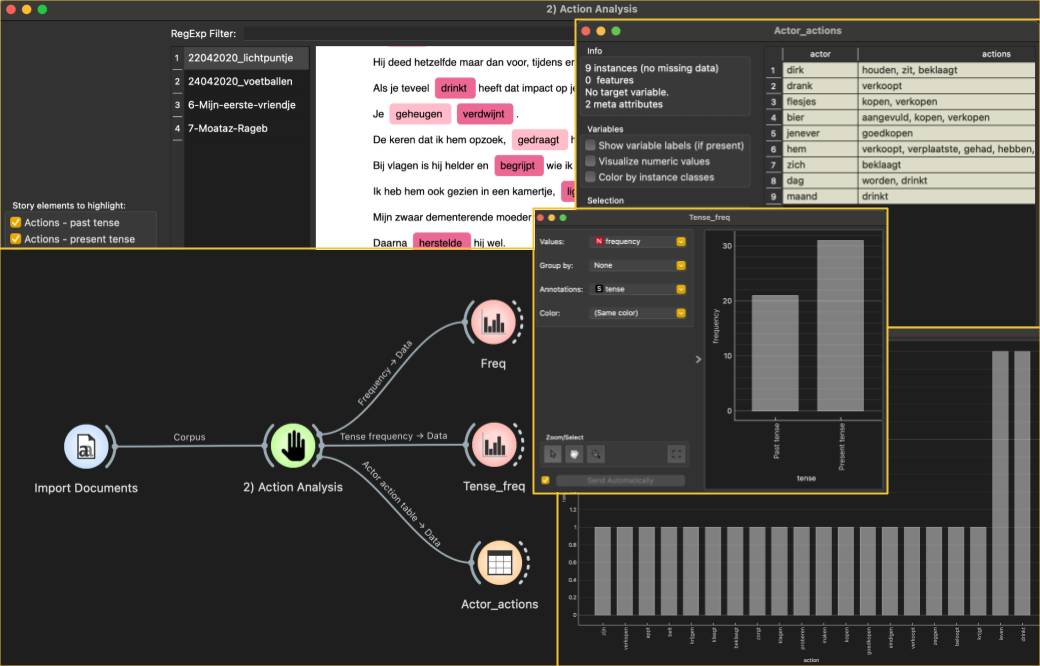
The Action Analysis widget provides a tool to support basic narrative analysis for actions in stories. It is part of the Orange3-Story-Navigator add-on for the Orange data mining software package. The widget highlights present and past tense actions, calculate their frequency, and identify actors associated with those actions, within in a textual story written in the Dutch language.
Main Features
Analyses actions in stories based on part of speech (POS) tagging and verb tense.
Allows selection of entity type to highlight (POS or NER).
Provides options to filter and highlight specific parts of speech.
Supports copying of analysis results to clipboard.
Allows for customization of POS checkboxes for each POS type.
Inputs
Story elements: The action widget always requires story elements from the elements widget. The widget will not work without this input.
Stories: A dataset of one or more textual story documents in Dutch.
Token categories (optional): a data table specifying one or more classification schemes of tokens or words. The table should consist of at least two columns. The first column is a list of words or tokens. All subsequent columns should contain strings which represent user-defined category labels for the corresponding word or token in the first column.
Outputs
Action stats: A data table with four columns.
storyid is the first column, matching with a particular story from the corpus
segment_id represents the amount of segments the story has been divided into (see the elements widget)
story navigator tag describes the verb tense, indicating the time at which an action takes place (i.e., past, present, or future)
wordcol describes the frequency of a verb tense per story id.
Custom tag stats (optional): A data table with five columns.
storyid, matching with a particular story from the corpus
segment_id represents the amount of segments the story has been divided into
category further sub-categorizes all the verbs in a story, with the type of sub-category depending on the column ‘classification’. The specific (sub)-categories can be manually specified, depending on the research interests, and is input for the elements widget. Note that a verb can be part of more than 1 category, depending on the context and quality of the verb.
freq describes the verb-frequency within each subcategory (i.e., column category), per story id.
classification is the higher-order category, as manually specified.
Action table: A data table with three columns.
action specifies all the verbs which occured accross the corpus. Duplicate verbs occur because the action table accounts for different type of entities associated with the action.
entities specifies all the actors associated with the action from the action column, accross the entire corpus.
entities_type further specifies the association between action and entity, based on the entity’s morphological property (e.g., singular proper noun, noun that is singular and non-proper, etc.).
Example usage: